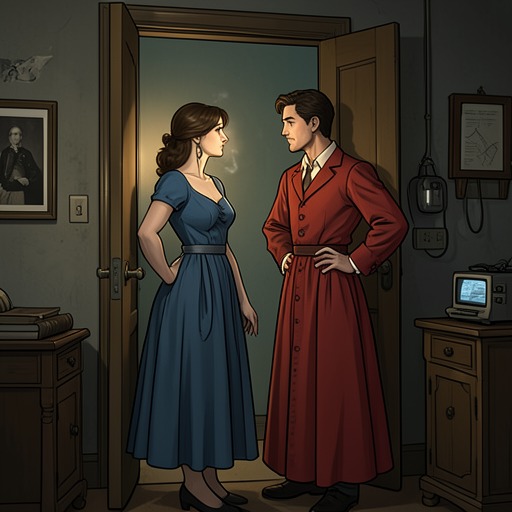
Charlaine Swain investigates inside Freddy Sykes’s home
Just One LookCharlaine Swain’s investigation of Freddy Sykes’s home turns a neighborly suspicion into a deliberate trespass. When Freddy’s routine fails to account for his absence, Charlaine stops treating the disturbance as someone else’s problem. She crosses into his yard, studies the house and its contents from outside, and takes the key hidden in a garden rock. The scene closes with her moving toward the back door: the decision to cross the threshold has been made, though the supplied episode stops before she enters.
Suspicion and Decision
The mystery first takes shape around an unfamiliar Asian man driving Freddy’s car. Charlaine has no established explanation for him, and the question matters because Freddy has few visitors; she cannot recall seeing any, though she acknowledges that she does not watch his house constantly. Her knowledge is instead the informal knowledge of a neighborhood: its routines make an unfamiliar presence feel out of place. The uncertainty is important. She has an anomaly, not proof of what it means.
Freddy’s absence from work supplies a second disturbance. Charlaine knows his usual schedule well enough to expect his garage door around ten-forty-five and to associate him with a desk near the window at H&R Block. Sometimes, when she parks at the same strip mall, she has seen him looking out, a pencil against his lips. That repeated, ordinary image makes the missing routine legible to her: this is not merely a stranger in a car, but a break in the pattern by which she has come to recognize Freddy’s day.
She checks the pattern rather than immediately going to his house. Using the yellow pages, she calls his workplace and speaks with a supervisor, pretending annoyance that Freddy is not there when expected. The supervisor apologizes and says Freddy is expected at any moment and will be asked to call. The call provides no explanation, only another unresolved gap. Charlaine’s unease persists even as she inventories food shopping, Mike’s shirts at the cleaner, lunch with a friend, and her son’s after-school karate. Those errands offer a ready-made reason to postpone action; instead, she abandons the list and takes her coat.
Her hesitation is also personal. Freddy is not someone to whom she believes she owes anything; she thinks of him as a reminder of her own failures and worries that investigating could expose the truth. Yet the possibility of exposure loses its power to deter her. The scene does not give her a settled account of why she acts. It shows the change more plainly: something feels wrong, the ordinary tasks no longer contain her attention, and she goes to Freddy’s house despite recognizing that the choice carries risk.
Crossing Into Freddy’s Yard
At first, Charlaine’s approach is framed as an act she can still minimize. She considers knocking and pretending to be neighborly, while questioning whether she is inviting danger simply because she wants drama in her life. Her thoughts circle around what might happen if Mike found out and whether that consequence would be so bad. She cuts short this self-analysis and continues toward the house. The movement is steadier than the justification: she is not certain what she hopes to find, but she does not turn back.
The gate between the backyards marks a concrete break with her previous behavior. Mike had installed a four-foot stockade fence two years earlier; a taller one would have required a swimming pool under the town ordinance. Charlaine opens the gate for the first time. What had been a boundary in the familiar arrangement of the neighboring homes becomes a passage she chooses to use. From Freddy’s side, she notices that his paint is peeling, the garden overgrown, weeds pushing through cracks in the walk, and patches of dead grass. Looking back at her own house from this angle, she sees that it too looks tired. Her inspection momentarily unsettles the division between the neglected neighbor’s property and her own domestic life.
At the back door she knocks softly, then pounds harder when there is no answer. Silence follows. She puts her ear against the door, though she knows the gesture is unlikely to help, and hears nothing. The shades are down, but gaps remain. Through one of them she sees a worn lime-green couch, a maroon vinyl recliner, a newer television, and old paintings of clowns. The details do not establish what has happened to Freddy; they make the interior visible without making it accessible. Charlaine is still outside, converting small glimpses into an incomplete account.
The House and the Unexplained Vehicle
The photographs on Freddy’s piano give the room a history Charlaine had not considered. One shows a wedding, which she takes to be Freddy’s parents. Another shows the groom in an army uniform; in a further photograph the same man holds a baby, smiling. The soldier and groom then disappear from the later photographs she can see, which show Freddy alone or with his mother. Charlaine cannot explain that absence, but the sequence makes the room more than a collection of furnishings: it suggests a family life whose visible record has narrowed over time.
She revises her first impression of the room. It is not simply immaculate; it seems preserved, unused, and untouched, as though caught in a time warp. Small figurines and more photographs reinforce the sense that the house holds a life arranged around its own past. Charlaine’s recognition that Freddy has a life is a shift in her attention, not a solved clue. Until now, she has treated him largely as a mirror of her own dissatisfaction. Looking through his window, she encounters traces of a private history that exceeds that role.
Circling toward the garage, she finds a rear window with a flimsy, lace-like curtain. The old wood almost gives way under her fingers, and peeling paint flakes from the ledge. Inside is a Ford Windstar, not a vehicle she associates with Freddy. The distinction matters because she knows the cars around town and because an unfamiliar man has already been linked to Freddy’s car. She considers whether the young Asian visitor might own the minivan, but does not accept the explanation as sufficient. The vehicle is a tangible clue, not an answer: someone or something connected to the situation remains unexplained.
The Hidden Key and the Threshold
By this point Charlaine has already understood that knocking and peering through windows will not tell her what is happening inside. Her attention turns to a rock in what used to be Freddy’s vegetable garden. She has seen him use it before and knows it is a hide-a-key container. The ordinary object changes the practical possibilities of the scene: the house is no longer protected from her by a locked back door alone.
Charlaine bends down, lifts the rock, slides back its small panel, and takes the key. It rests in her palm, catching the sunlight. The action makes the investigation materially different from observation. She has not merely noticed a suspicious car or looked through a gap in the shades; she has taken the means to enter a neighbor’s home. The text marks this as the line from which there is no going back, emphasizing her awareness that the decision has consequences even though she cannot yet name them.
She moves toward the back door with the key. That is the endpoint of the episode, not evidence that she has entered or discovered what is inside. The unresolved ending preserves the suspense around Freddy’s absence and the unfamiliar vehicle while making Charlaine’s own choice unmistakable. The domestic boundary she crossed first was the gate between the yards; now the key brings her to the threshold of the house itself. In the same sequence, her curiosity becomes action, and the quiet routines of neighborhood watching give way to a risk she has knowingly accepted.